Sep 07, 2026•7 min read
Announced, Approved, or Actually Being Built?
"A press release is not a crane. The single distinction that separates real progress from a beautiful rendering is where most Dubai money is quietly lost."
By Shashi S. Piptan Global Investment Advisor and Government Policy Consultant
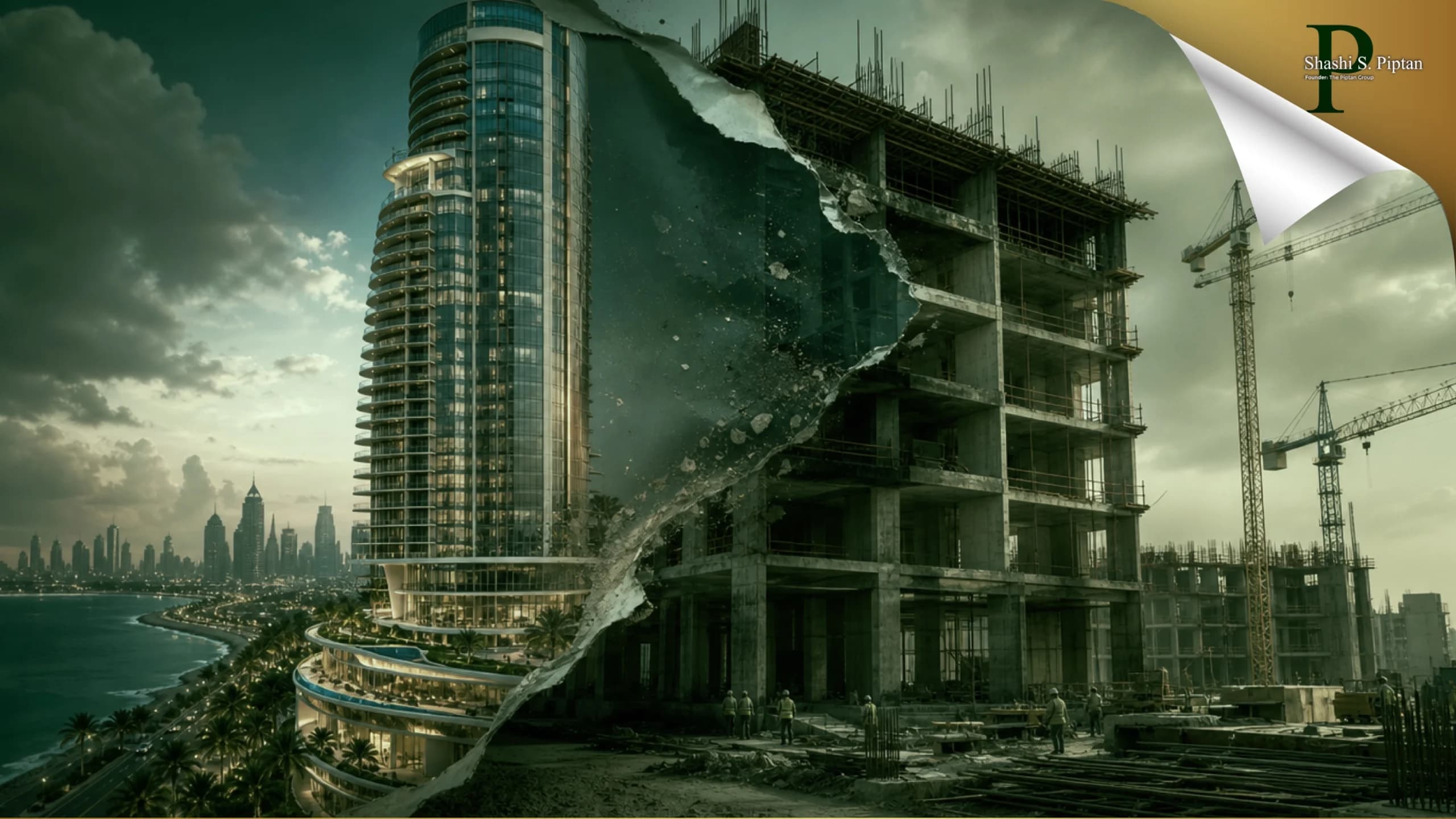
There is a sentence I have heard in more meetings than I can count, and it makes me wince every time. "It has been announced." The investor says it as though the matter is settled, as though an announcement and a finished building sit on the same shelf. They do not. Between the announcement of a project and the moment it genuinely changes the value of the land around it lies a long, treacherous corridor, and the investors who confuse the entrance of that corridor with its exit are the ones who fund other people’s learning.
This is the most useful discipline I can describe in a short article, so I will state it as simply as I can. A project can exist in at least three very different states, and they are worlds apart. It can be announced, which is a statement of intent. It can be approved, which is a statement of permission. Or it can be actually being built, which is a statement of committed capital, awarded contracts and physical progress you can measure. The words sound similar. The risk they carry is not remotely similar. And a great deal of money in Dubai is lost by people who cannot, or will not, tell them apart.
A ghost that came back to life
The cleanest illustration in the city right now is Palm Jebel Ali. Nakheel launched it in the early 2000s as a grander successor to Palm Jumeirah, and the expensive land-formation phase was largely completed before the 2008 financial crisis cut the story in half. For roughly fifteen years the island sat offshore as reclaimed land and little else, one of the most visible reminders in Dubai that a project can be announced, can even be partly shaped in the sea, and still stall into dormancy. Anyone who had bought purely on the strength of the original announcement spent those fifteen years holding a promise, not an asset.
Then the state of the project changed, and it changed in stages that are worth watching closely. In May 2023 a new master plan was approved and the island was relaunched. In 2024 infrastructure contracts began to be awarded, which is a different and more serious signal than a relaunch, because contracts move money. By late 2025, inspection reporting placed an early villa cluster on one frond at roughly twenty-two per cent complete, and in April 2026 a multi-billion-dirham deal was signed to build hundreds more villas across several fronds. First handovers are being targeted from 2026, with further fronds aiming at 2027 and broader completion pushed toward the end of the decade and beyond. Some fronds have still not seen building begin at all.
Planning approval anchors intent. Awarded contracts and rising concrete are what begin converting intent into a city.
Read that sequence again, because it contains the entire lesson. Announcement, dormancy, relaunch, approval, awarded contracts, measurable construction on some parts and nothing yet on others. At every one of those points the project was technically "real," and yet the risk of buying into it, and the price you should sensibly pay, were completely different at each stage. The investor who treated the 2023 relaunch as identical to the finished island of the 2030s was making a serious category error, however excited the market around them happened to be.
It helps to hold a clean counter-example alongside it. The Metro Blue Line, which I have written about elsewhere in this series, sits at the far, reassuring end of the same spectrum. It was announced, then approved, and then, crucially, moved into genuine construction: a foundation stone laid in June 2025, contracts of around twenty and a half billion dirhams awarded, tunnelling machines actually in the ground, and datable progress milestones you can check. When I compare that with a district whose future rests on a project still living in the announcement stage, I am not comparing two projects. I am comparing two entirely different risk profiles that happen to share the vocabulary of progress. The same words, "it is happening," mean radically different things depending on which state the project is truly in.
Why the confusion is so expensive
The reason this distinction costs money rather than merely embarrassment is that markets do not price projects on facts alone. They price them on confidence, and confidence travels through headlines faster than concrete travels through a construction schedule. When a glamorous project is announced, the surrounding land and off-plan units can re-rate almost immediately, pricing in a completion that is still years and several unsigned contracts away. If you buy at that moment, you are paying today for a future that has not yet been funded. If the corridor between intent and delivery turns out to be long, and in Dubai it often does, you carry years of cost with no rental income and no certainty, exactly the position that punished so many buyers of the first Palm Jebel Ali.
The opposite error is just as real, and I see cautious investors make it constantly. They dismiss a project as vapour precisely when it has quietly crossed from announced into genuinely-under-construction, because the internet’s memory lags the site by months or years. The narrative still says "stalled" while the cranes say otherwise. That lag can create a window, a period where a funded, progressing project still carries the discount of an abandoned one. Seeing that gap, and having the nerve to act on it, is one of the most profitable things a disciplined buyer can do. But you cannot see it at all unless you have first learned to read the states correctly.
The signals that separate intent from delivery
So how do I tell them apart? I look at the boring documents, not the beautiful ones. A rendering tells me nothing. A master-plan approval tells me the government has granted permission, which is necessary but nowhere near sufficient. Awarded infrastructure and construction contracts tell me capital has been committed and someone is now contractually obliged to build. Escrow arrangements registered with the authorities tell me buyer money is ring-fenced against progress rather than spent on the next launch. Published, datable construction milestones tell me the sequence is actually advancing. Access roads, utilities, marine works and power provisioning being tendered in the right order tell me the project is being built as a system and not staged for a brochure. None of these are secrets. They are simply unglamorous, and glamour is what most buyers are shopping for.
That is the discipline in outline, and it is the discipline that most reliably signals a genuine professional at work. But an outline is not a tool. Knowing that "announced, approved and being built" are three different states is the beginning of the analysis. It is not the analysis.
Where I stop, and where the book begins
I have given you the distinction, and I have given you the reason it is expensive to ignore. What I have not given you, and will not give you here, is the full staged test I use to grade a project along that corridor and to time an entry against it: the specific checkpoints, the sequence in which they must fall, the point at which a discount is a genuine opportunity rather than a warning, and the thresholds that tell me to wait rather than buy. That framework is one of the load-bearing chapters of The Urban Evolution of Dubai, because it is one of the few things in this market that consistently separates the investor who compounds from the one who funds everyone else’s education. For now, do just one thing with this article. The next time you hear the words "it has been announced," ask the only question that matters: announced, approved, or actually being built?
References and further reading
- The National: Palm Jebel Ali megaproject progress, units on track for 2027
- Time Out Dubai: Palm Jebel Ali timeline and 2026 villa contract
- Palm Jebel Ali timeline: announcement, dormancy, relaunch, reactivation
- Palm Jebel Ali current construction status (August 2026)
- Propsearch: Palm Jebel Ali project data and history