Sep 16, 2026•10 min read
From Pearls to Petroleum: The Making of Modern Abu Dhabi
"The pearl took centuries to build and a decade to lose. The oil arrived, in effect, all at once. What Abu Dhabi did with it was a choice, not a gift."
By Shashi S. Piptan
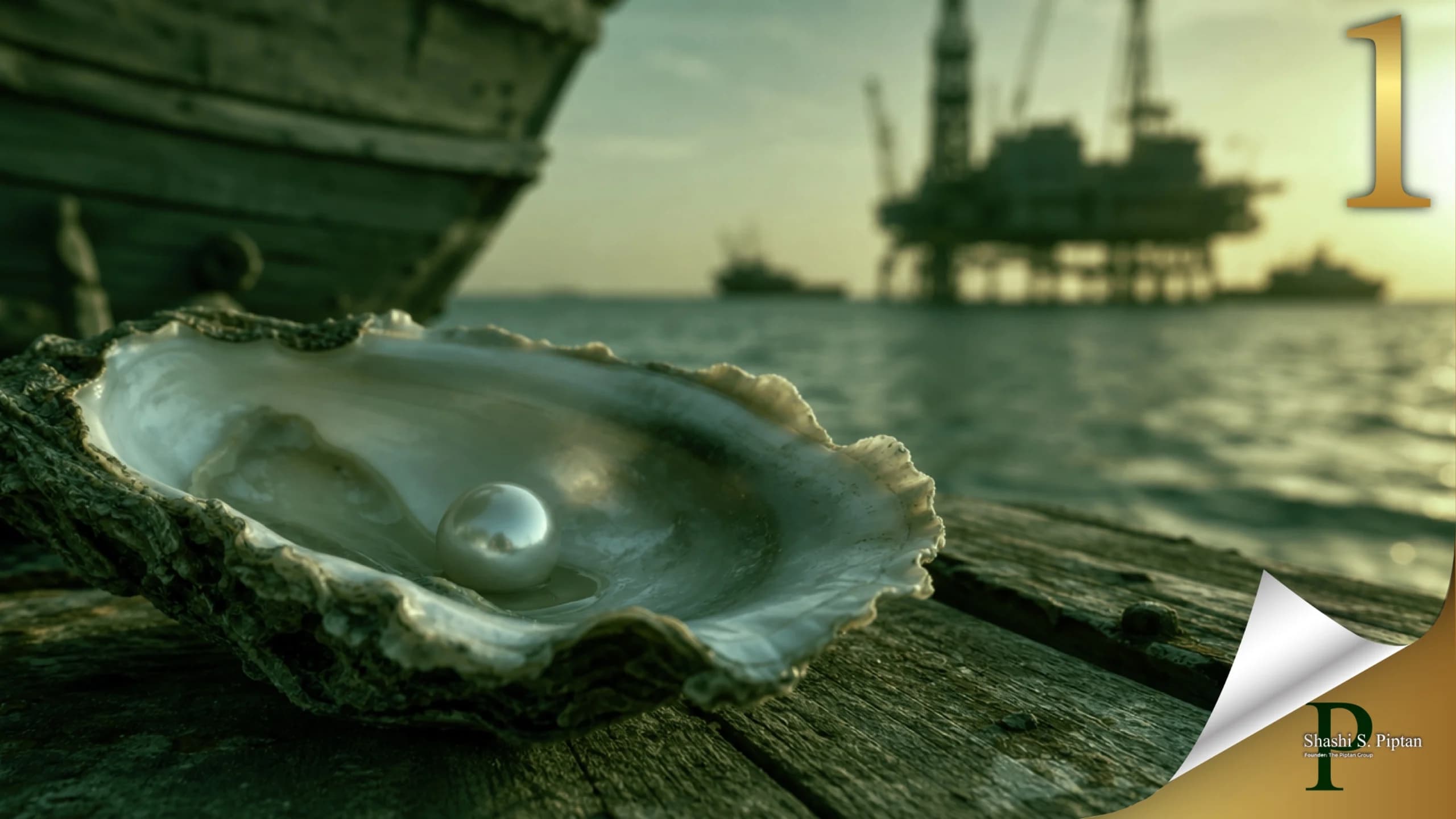
THE ABU DHABI SERIES · THE ECONOMIC HISTORY AND FUTURE OF ABU DHABI Arc I: Foundations, History and Institutional Identity
To understand Abu Dhabi today, you have to resist the easiest mistake in the region: reading it as Dubai with more oil. Its origins are different, and so is everything that followed.
I want to begin this series where the emirate itself began, because almost every misjudgement I see foreign investors make about Abu Dhabi has the same root. They arrive with a mental model built in Dubai, and they quietly assume that Abu Dhabi is the same story told at a slower pace and with a larger bank balance. It is not. The two emirates share a federation, a currency and a coastline, but they were shaped by different economies, different pressures and different founding decisions, and those differences still govern how each behaves today. If you want to read Abu Dhabi accurately, you have to read it on its own terms, and that means starting long before the oil.
This first article is deliberately historical, and I make no apology for that. A reader in a hurry might prefer to skip to the sovereign wealth funds or the artificial intelligence strategy. I would ask them to be patient, because the caution that defines Abu Dhabi’s institutions, the temperament of its capital, and the strategic conservatism that outsiders often mistake for slowness, all of it is inherited from a past most visitors never think about. You cannot assess what Abu Dhabi is building without understanding what it was built out of.
An economy that lived and died by the pearl
For most of its recorded history, the society that became Abu Dhabi lived at the edge of survival. The people were largely the Bani Yas, a tribal confederation whose heartland lay inland at the Liwa oasis and whose ruling section, the Al Bu Falah, would give rise to the Al Nahyan family. Life was seasonal and hard: date cultivation inland in the cooler months, and in the summer the pearl banks of the Gulf. Pearling was not a picturesque tradition. It was gruelling, dangerous, debt-bound work, with divers descending on a single breath, again and again, through a short and brutal season, and it was the economic spine of the entire coast.
That spine snapped within a single generation, and the manner of its breaking matters. In the late 1920s and through the 1930s two forces arrived almost together. The Japanese perfection of the cultured pearl collapsed the price of the natural pearl that the Gulf sold, and the global economic depression destroyed the luxury demand that remained. An economy with essentially one export watched that export lose its value almost overnight. The hardship that followed was severe and is not exaggerated in the local memory. Abu Dhabi entered the mid-twentieth century as one of the poorer places on the Arabian coast, its single industry gone and no obvious replacement in sight.
I dwell on this because it is the founding economic fact of the emirate, and it teaches a lesson the region has never entirely forgotten. Abu Dhabi has already lived through the complete collapse of a one-commodity economy once. The knowledge that a single resource can vanish is not a theoretical risk imported from a business school. It is written into the emirate’s own history, within living memory of the generation that built the modern state. When I later discuss why Abu Dhabi institutionalised its oil revenue so carefully rather than simply spending it, this is where that instinct comes from.
It is worth adding that the pre-oil economy was never solely the pearl, and the inland dimension matters for understanding the emirate’s character. Away from the coast, the Bani Yas heartland at the Liwa oasis and the settlements around Al Ain sustained a date-growing, herding and falaj-irrigated agricultural life that gave the confederation a second centre of gravity, one rooted in land rather than sea. This inland, tribal, agrarian foundation is part of why Abu Dhabi’s temperament differs from that of the trading ports. Its historical centre was not a market on a creek but a dispersed society balancing coast and desert, and the long attachment to the Al Ain oasis and the contested Buraimi lands anchored its sense of territory in a way a purely maritime economy would not have. When I describe Abu Dhabi as more inward and more conservative than Dubai, this dual coast-and-desert inheritance is a large part of what I mean.
A settlement, a spring and a ruling family
The town of Abu Dhabi itself is younger than many assume. The Bani Yas are generally held to have settled the island in the 1760s, drawn, in the enduring local account, by the discovery of fresh water, and the name that attached to the place, commonly rendered as Father of the Gazelle, belongs to that founding story. From the 1790s the Al Nahyan established the island as the seat of the ruling family of the Bani Yas confederation, and from there the dynasty that still leads the emirate governed a small, poor and strategically exposed territory. Through the nineteenth century the coast entered a series of maritime treaties with Britain, the arrangement that gave the Trucial States their name, and Abu Dhabi lived within that protected but constrained order for more than a century.
That constrained order had economic consequences that outlasted it. Under the maritime treaties the coast’s external relations ran through Britain, and the sheikhdoms were, for the better part of a century, small polities with limited room to shape their own commercial destinies. Abu Dhabi therefore entered the oil age not as a sovereign state with developed institutions but as a recently protected territory building a modern administration almost from nothing. The speed with which it later constructed a functioning state apparatus reads differently, and more impressively, once you remember how little institutional scaffolding existed to begin with. This too is context the celebratory accounts skip: the transformation began from a far lower institutional base than the polished result makes it easy to imagine.
None of this resembles the Dubai story, and the contrast is the point. Dubai’s nineteenth and twentieth-century identity formed around trade, the creek, and an early instinct for openness to merchants and movement. Abu Dhabi’s formed around tribe, land, pearling and a more inward, more conservative center of gravity. When people are surprised that the two emirates behave so differently as investors and as governments today, they are really expressing surprise that two places with genuinely different histories produced genuinely different institutions. That should not be surprising at all.
The turn: oil, and the decade that changed everything
The break in the story came from beneath the sea. After surveys stretching back to the 1930s and concessions granted in the following decades, oil was struck offshore at the Umm Shaif field in 1958, followed by onshore discoveries in the desert. In 1962 the first cargo of Abu Dhabi crude was exported. Within a few years an emirate that had been counting a modest and precarious income was receiving revenues on a scale its previous economy could not have imagined. The pearl had taken centuries to build and a decade to lose. The oil arrived, in effect, all at once.
It is tempting to treat that moment as a simple stroke of fortune, and in geological terms it was. But I would caution against reading the transformation that followed as automatic. Sudden resource wealth has ruined at least as many states as it has enriched. The relevant historical question is not whether Abu Dhabi found oil, which was luck, but what it chose to do with the proceeds, which was not. That choice is bound up with the figure who took the leadership of the emirate as the money began to flow.
Sheikh Zayed and the decision to build a state
Sheikh Zayed bin Sultan Al Nahyan became Ruler of Abu Dhabi in 1966, having governed the eastern region around Al Ain in the years before. His significance to this series is not ceremonial. The defining decisions of the period were institutional: to channel the new oil revenue into physical infrastructure, into the beginnings of a modern administration, and, critically, toward the creation of a wider political union rather than a single enriched emirate standing alone. I will assess the machinery of Abu Dhabi’s wealth in the next article, but its origin lies here, in a choice to treat the oil as the foundation of a durable state rather than as a windfall to be consumed.
The union itself followed in 1971. As Britain withdrew from the Gulf, the seven Trucial sheikhdoms negotiated their way, unevenly and with genuine uncertainty, toward federation, and on the second of December 1971 the United Arab Emirates came into being, with Sheikh Zayed as its first President and Abu Dhabi as its capital. A seventh emirate, Ras Al Khaimah, joined the following year. I want to be careful and neutral in how I characterise this: the federation was a negotiated political settlement, not an inevitability, and Abu Dhabi’s willingness to underwrite much of it financially was a strategic decision with long consequences. The emirate became, from the outset, the fiscal anchor of the union it had helped to create.
Reading the inheritance honestly
What does this history actually give an investor or a policy reader today, beyond context? Three things, I would argue, and each of them cuts against a lazy reading of the emirate. First, Abu Dhabi’s conservatism is earned, not affected. A society that watched one monocommodity economy collapse entirely, and then received a second commodity windfall, had every reason to build institutions designed to outlast the resource. That is precisely what it did, and it explains a caution that hurried outsiders misread as timidity.
Second, the single-resource question is the emirate’s founding problem, not a modern anxiety invented by analysts. The entire later arc of this series, diversification, the energy transition, the wager on new industries, is at heart one long attempt to avoid repeating the pearling collapse in a new form. When I later assess how far diversification has genuinely progressed, I am really asking whether the lesson of the 1930s has been fully learned or only partly. That is a fair question, and the honest answer is not a simple yes.
Third, and most useful of all, Abu Dhabi is not Dubai, and the difference is structural rather than stylistic. Dubai built an identity on trade, leverage, openness and speed, monetising its position as a hub. Abu Dhabi built one on resource wealth, sovereign capital, institutional patience and the responsibilities of being the federal anchor. Neither model is superior in the abstract; they are answers to different starting conditions. But an investor who prices Abu Dhabi as though it were simply a wealthier, slower Dubai will misjudge its risk, its temperament and its intentions at every turn. The rest of this series is written against that error.
So we begin here, with a poor pearling coast that lost everything and then found everything, and with a set of decisions taken in the 1960s and 1970s that turned a windfall into a state. Everything that follows, the funds, the national oil company, the financial centre, the cultural district and the bet on intelligence, is a chapter in the same underlying story: a place that already knows, from its own past, what happens when you depend on one thing, and has spent half a century trying not to depend on one thing again. Whether it has succeeded is the question this series exists to examine honestly.