Sep 09, 2026•7 min read
"The Gulf" Is Not One Market
"Four or five countries, several currencies of confidence, a whole region’s worth of exposure. It sounds like textbook diversification. And a great deal of the time, it is nothing of the sort. It is a single bet, placed four times, on the same underlying thing."
By Shashi S. Piptan Global Investment Advisor and Government Policy Consultant
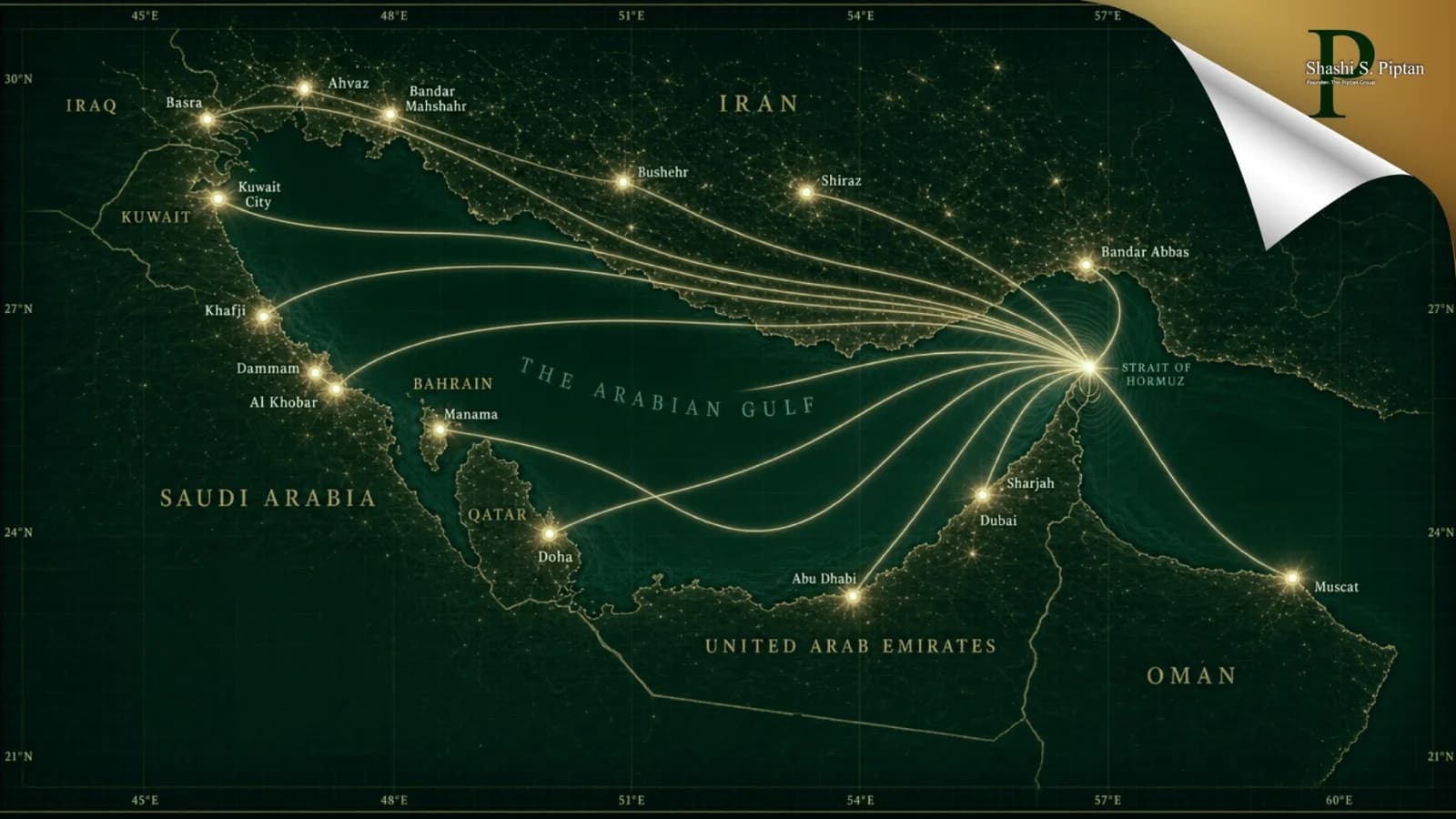
A phrase I hear constantly, usually from intelligent and well-travelled investors, is "I am diversified across the Gulf." They will list it proudly: an apartment in Dubai, a plot in Riyadh, a unit in Doha, perhaps something in Manama or Muscat. Four or five countries, several currencies of confidence, a whole region’s worth of exposure. It sounds like textbook diversification. And a great deal of the time, it is nothing of the sort. It is a single bet, placed four times, on the same underlying thing.
This is one of the more expensive misunderstandings I encounter, and it is expensive precisely because it feels so responsible. The instinct to not put everything in one country is sound. The error is in believing that the six states of the Gulf Cooperation Council are six independent markets. Geographically they are neighbours. Economically and geopolitically they are, for the purposes that matter to an investor in a crisis, far more correlated than their separate flags suggest. To spread across them without understanding that correlation is to mistake the number of assets for the number of risks.
One region, one engine, one set of risks
Start with what the GCC actually is. Six states, founded as a bloc in 1981, with a combined economy above two trillion US dollars and control of roughly a third of the world’s proven oil reserves, all sharing a population of only about sixty million. Every one of them is still, to differing degrees, an economy whose fiscal health flexes with the price of hydrocarbons. Every one is pursuing a national transformation vision, Saudi Vision 2030, the UAE’s economic agenda, Qatar National Vision 2030, Bahrain’s and Oman’s equivalents, and every one of those visions depends on the same broad conditions: stable energy revenue, continued foreign capital inflows, and above all regional peace. When those conditions are good, all six tend to do well together. When they deteriorate, they tend to deteriorate together. That is the definition of correlation, and it is baked into the geography.
The diversification these visions are creating is real, and I do not want to understate it. The UAE now derives well over two thirds of its GDP from non-oil sectors and is the most diversified economy in the bloc; Saudi Arabia opened parts of its property market to foreign buyers from January 2026; sovereign wealth funds across the region are pushing capital into technology, logistics and industry. But notice what all of that diversification still shares. It is funded, ultimately, from the same well, it is exposed to the same energy-price cycle, it sits under the same security umbrella, and it is vulnerable to the same regional shocks. Diversifying the economy of one state is not the same as diversifying an investor’s risk across states that all move to the same music.
Four assets are not four risks if a single event can move all four on the same afternoon.
When the correlation stops being theoretical
For years this correlation was an abstraction that appeared only in academic papers, easy to nod at and easy to ignore. In 2026 it stopped being abstract. When conflict in the region escalated and the Strait of Hormuz was disrupted, the shock did not politely confine itself to one country. Energy prices spiked, war-risk insurance for Gulf waters was withdrawn or repriced within days, and risk premiums rose across the entire bloc at once. An event centred on a single waterway reached into the pricing of assets in every GCC state simultaneously, because every GCC state depends on that waterway, that energy complex and that perception of regional stability. The investor who was "diversified across the Gulf" discovered, in the space of a fortnight, that his four assets had four addresses but one risk.
This is the point I most want to land. The moment that reveals whether you were truly diversified is not the calm year, when everything rises together and correlation looks like a free lunch. It is the crisis, when everything you believed was independent turns out to move as one. Genuine diversification is defined by what happens to your portfolio on its worst day, not its average one. And on the worst day, a basket of purely-Gulf assets can behave far more like a single leveraged bet on regional stability than like the balanced spread its owner imagined.
It is worth being clear about why the correlation runs so deep, because the mechanism is not mysterious. The Gulf states share more than a coastline. They share a dependence on the same energy complex, a reliance on the same handful of maritime chokepoints through which their exports and imports must pass, a common exposure to the same regional security dynamics, and, for most of them, currency regimes anchored to the same external benchmark. Capital flows into the region on a single broad thesis about Gulf stability and growth, and when that thesis is questioned, it tends to reprice the whole region rather than politely distinguishing between its members. These are not incidental similarities. They are the deep structure that makes six separate flags behave, under stress, like one position.
The distinctions that actually matter
None of this means the Gulf is uninvestable, or that its states are interchangeable. The opposite is true, and this is where the analysis becomes interesting rather than merely cautionary. The six markets are correlated, but they are not identical. They differ in the depth of their diversification, in their fiscal buffers, in their currency arrangements, in their exposure to specific chokepoints, in the maturity of their property law and in how a given shock actually transmits to a given asset class. A serious investor does not respond to correlation by fleeing the region. He responds by learning to tell the members apart on the dimensions that decide how they behave when it matters, and by understanding which of his holdings genuinely offsets another and which merely doubles the same wager.
That is a comparative discipline, and it is a real one. It is the difference between owning four things and owning a portfolio. It is what turns "I have assets in several Gulf countries" into a defensible statement about risk rather than a comforting story about geography. And it points, incidentally, to where genuine diversification for a Gulf-heavy investor usually has to come from: not from adding a fifth address inside the same correlated bloc, but from holding something whose fortunes are not tied to the same waterway, the same energy cycle and the same regional peace. Real diversification is found where the correlation ends, and the correlation, in the Gulf, ends further out than most investors would like to believe.
Where the tool lives
What I have done in this article is expose the trap: the way a spread of Gulf assets can disguise a single correlated bet, and the way a crisis strips that disguise away. What I have not done, and will not do here, is hand you the comparative framework I use to assess these markets side by side, the specific dimensions on which I grade them, the way I map how a shock travels from a regional event to a particular asset in a particular emirate, and the method for building genuine, rather than cosmetic, diversification within and beyond the region. That framework is the heart of the regional chapter of The Urban Evolution of Dubai, because it is precisely the tool that turns a nervous "am I diversified?" into a confident answer. For now, hold on to the uncomfortable version of the question. Count your risks, not your assets. In the Gulf, the two numbers are rarely the same.
References and further reading
- World Bank: GCC economies, resilience and diversification (Gulf Economic Update)
- PwC Middle East: oil-funded growth or true diversification, metrics to watch
- Khaleej Times: GCC diversification and Saudi opening real estate to foreigners
- The Middle East Insider: GCC members ranked, what unites and divides the bloc
- Congressional Research Service: Strait of Hormuz and regional energy exposure