Sep 07, 2026•8 min read
The Skyline Is a Distraction
"The towers everyone photographs tell you where money has already gone. Value in Dubai is decided by a layer most buyers never look at."
By Shashi S. Piptan Global Investment Advisor and Government Policy Consultant
Every visitor to Dubai goes home with the same photograph. The Burj Khalifa dissolving into a pink dusk, the Marina towers catching the last of the light, a wall of glass that looks like the future arrived a decade early. I understand the pull of that image. I have taken it myself, more than once. But after two decades advising private investors, family offices and governments on where capital should actually go, I have learned to treat the skyline with suspicion. It is the most photographed and least informative object in the city.
This will sound strange coming from someone whose professional life is bound up with this market, so let me say it plainly. The skyline is a distraction. It records where money has already been spent. It tells you almost nothing about where value will be created next. The buyer who chooses a property because the view is spectacular is reading the one page of the story that has already been written, and ignoring the chapters still being drafted underneath.
The city you cannot see from the helicopter
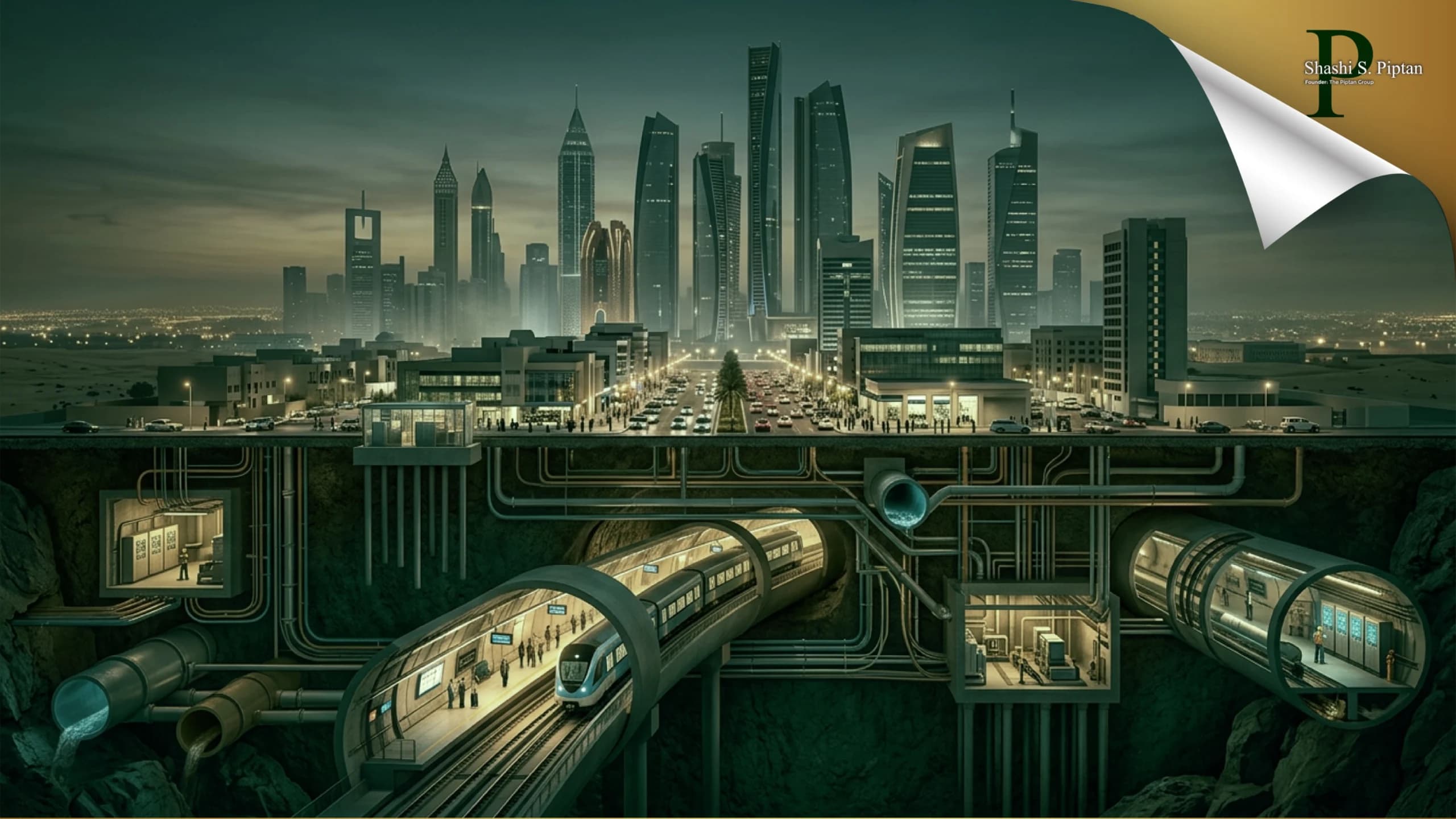
Beneath every district in Dubai there is a second city, and it is the one that decides prices. It is made of things nobody queues to photograph: the trunk sewer lines and their spare capacity, the substations and the load they can carry, the desalinated water mains, the road hierarchy and where it chokes at rush hour, the fibre, the district cooling plants, and above all the rail. This invisible city is the true balance sheet of a neighbourhood. When it is generous and forward-planned, a district can absorb decades of growth without strangling itself. When it is thin, a beautiful tower can sit in a place that will never comfortably carry the population its developers imagined.
Two towers can look identical from the air and have entirely different futures. One sits above a planned interchange, inside a zone the government has designated for densification, with utility headroom already engineered for the population that has not yet arrived. The other sits in a pocket that looks the same today but was drawn as a low-density edge, with a single congested access road and no transit on any published map. The glass is the same. The concrete is the same. The trajectory is not remotely the same. The camera cannot tell them apart. The plan can.
I want to be precise about why this matters commercially, because it is easy to treat it as an aesthetic point when it is really a pricing one. When you buy a property you are not only buying a box of air with a view. You are buying a claim on a neighbourhood’s future, and that future is rationed by capacity. A district with generous headroom in power, water, drainage and roads can welcome the next wave of residents, the next school, the next hospital and the next office campus without the quality of daily life collapsing. A district running close to its limits cannot, and no amount of marketing gloss changes the arithmetic. The invisible city is where the ceiling on a neighbourhood sits, and the ceiling is what your exit price will one day press against.
The layer that actually moves the price
Consider the single largest piece of infrastructure Dubai is building right now. The Roads and Transport Authority has committed roughly twenty and a half billion dirhams to the Metro Blue Line, a thirty kilometre route with fourteen stations threading through the eastern and north-eastern districts that road-dependence has held back for years. Sheikh Mohammed bin Rashid laid the foundation stone in June 2025, tunnelling is under way, and the opening is targeted for the ninth of September 2029, the metro network’s twentieth anniversary. Around fifteen and a half kilometres of the line runs underground and the rest is elevated. This is not a rumour or a rendering. It is a funded, contracted, physically progressing object.
The historical pattern behind it is not a secret either. Analysis of the existing network has shown that homes within walking distance of Dubai Metro stations tended to appreciate faster than the city as a whole. In the stretch from 2010 to 2022, values near Red Line stations outpaced the citywide average, and rents in those pockets held firm even in years when the wider rental market softened. The RTA itself has pointed to uplift of up to a quarter in land and property values around new stations. Rail, in other words, is one of the most reliable value signals this city produces. It is written into the ground years before it is written into the price.
The glass is the same. The concrete is the same. The trajectory is not. The camera cannot tell them apart. The plan can.
Why "there is a metro coming" is not a thesis
Here is where most readers stop too early, and where the amateur and the professional part company. It is tempting to convert "the Blue Line is coming" straight into "buy near the Blue Line" and consider the analysis complete. It is not complete. It has barely begun. A metro announcement is not a station entrance. A station entrance is not walkability. Walkability is not district maturity. And district maturity is not a guaranteed return. Each of those arrows is a separate question, and each one can fail independently of the others.
A line can improve transport access at the corridor level while leaving an individual building with almost no practical advantage, because the nearest entrance is a hot fifteen-minute walk across an arterial road nobody wants to cross in July. A station can raise a district’s visibility and its marketing language while new supply, service charges and weak pedestrian design quietly dilute the actual effect on price. Infrastructure benefit is real at the scale of the map and uneven at the scale of the front door. The person who understands only that "rail lifts value" will overpay for the wrong side of the tracks and congratulate himself for being sophisticated.
Reading the plan beneath the plan
The skyline everyone admires is not the cause of Dubai’s value. It is the downstream visible residue of decisions taken years earlier in documents most investors never open. The Dubai 2040 Urban Master Plan concentrates growth around five urban centres and commits the emirate to a twenty-minute-city principle, the idea that most daily needs should sit within a short walk or cycle of home. Those are not slogans. They are the instructions the physical city is being built to follow. The towers are the last chapter of a book whose plot was set at the start.
The investor’s real job, the one that actually compounds, is to read that layer before it becomes visible in glass and steel, and to price the gap between what the plan intends and what has genuinely been committed to the ground. That is a very different activity from admiring a view. It is closer to reading a company’s capital expenditure schedule than to reading its brochure. And it is precisely the layer that the photograph, by its nature, cannot show you.
What I have shown you, and what I have not
I have tried to convince you of one thing in this piece: that a hidden layer, and not the skyline, decides value in Dubai, and that learning to see it is the difference between guessing and investing. That much I am happy to give away, because it costs the city nothing and it will make you a more careful buyer tomorrow morning. What I have deliberately not done is hand you the method for locating that layer and pricing it, station by station, plot by plot, plan clause by plan clause. That method, the way I actually read the ground before the market does, is the spine of The Urban Evolution of Dubai, and it is the reason the book exists. The skyline will still be there when you have read it. You will simply stop mistaking it for the point.